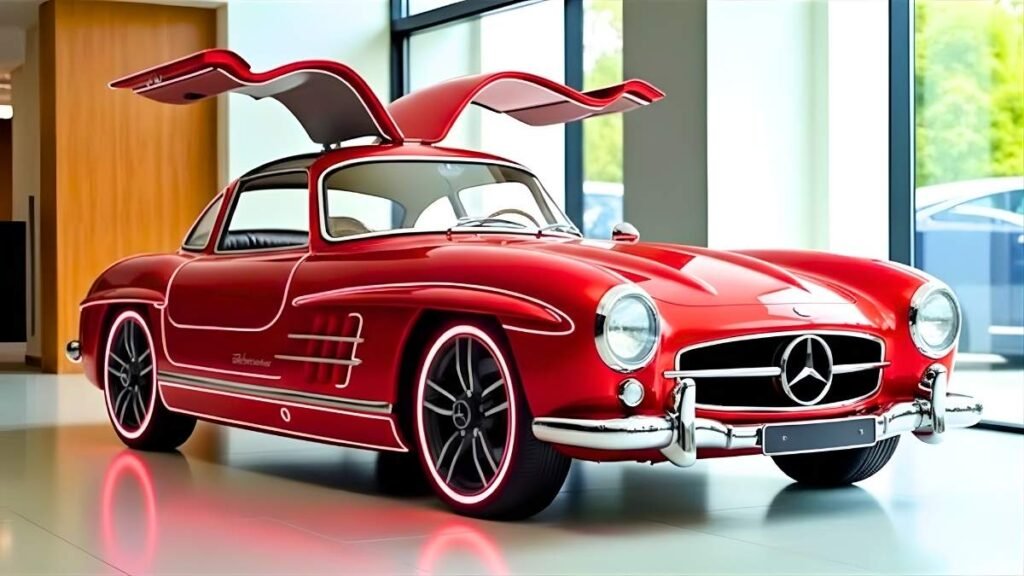
Mercedes 300 SL Gullwing : Few cars in automotive history have achieved the legendary status of the Mercedes 300 SL Gullwing. Introduced in the mid‑1950s, it combined groundbreaking engineering with a design that remains iconic to this day. The Gullwing’s distinctive upward‑opening doors, advanced fuel‑injected engine, and racing pedigree made it one of the most admired sports cars of its era. The story of the final Gullwing ever built is not just about a single car, but about the end of a chapter in automotive history that continues to inspire enthusiasts and collectors worldwide.
Origins of the Gullwing
The 300 SL was born from Mercedes-Benz’s success in motorsport. The company’s W194 race car had proven itself on the track, and executives saw an opportunity to translate that success into a road‑going sports car. In 1954, the 300 SL Gullwing was unveiled at the New York International Auto Show, immediately capturing attention with its futuristic design and impressive performance. It was the first production car to feature direct fuel injection, a technology that gave it remarkable speed and efficiency for its time.
Production Years
Between 1954 and 1957, Mercedes produced just over 1,400 Gullwing coupes. Each car was hand‑assembled with meticulous attention to detail, ensuring quality and exclusivity. The limited production run added to its desirability, and the Gullwing quickly became a symbol of prestige. By the time the final Gullwing rolled off the production line, it had already cemented its place as one of the most important sports cars of the twentieth century.

Design and Engineering
The Gullwing’s design was dictated by engineering necessity. Its tubular spaceframe chassis was light and strong, but the high side sills made conventional doors impractical. Engineers solved this challenge by creating doors that opened upward, resembling the wings of a gull. This feature became the car’s defining characteristic. Combined with its sleek bodywork, long hood, and balanced proportions, the Gullwing was both functional and beautiful. Under the hood, the 3.0‑liter straight‑six engine delivered around 215 horsepower, allowing the car to reach speeds of up to 250 km/h, an extraordinary figure for the 1950s.
The Final Gullwing
The last Gullwing ever built holds a special place in automotive history. As the final example of a groundbreaking model, it represents the culmination of Mercedes-Benz’s vision for a road‑going sports car inspired by racing. This car was assembled with the same craftsmanship as its predecessors, but its significance lies in being the closing chapter of the Gullwing era. Collectors and historians regard it as a priceless artifact, embodying the spirit of innovation and elegance that defined the model.

Market Value and Collectability
Today, the Mercedes 300 SL Gullwing is one of the most sought‑after classic cars in the world. Auction prices regularly reach several million dollars, depending on condition, provenance, and originality. The final Gullwing ever built is considered even more valuable due to its historical importance. For collectors, owning this car is not just about possessing a rare automobile, but about holding a piece of history that symbolizes the golden age of sports car design.
Cultural Impact
The Gullwing transcended the automotive world to become a cultural icon. It appeared in films, magazines, and advertisements, often associated with glamour and sophistication. Celebrities and influential figures of the 1950s and 1960s were drawn to its unique style and performance. The final Gullwing embodies this cultural legacy, reminding us of a time when cars were not only machines but symbols of aspiration and progress.

Comparison with Other Classics
While many classic cars from the same era are celebrated, few rival the Gullwing’s combination of innovation and design. Models like the Ferrari 250 GT or Jaguar E‑Type are admired, but the Gullwing’s distinctive doors and pioneering technology set it apart. The final Gullwing stands alongside these icons as a benchmark of automotive excellence, representing the pinnacle of Mercedes-Benz’s engineering achievements of the time.
Influence on Future Models
The Gullwing’s legacy continued to influence Mercedes-Benz long after production ended. Decades later, the company introduced the SLS AMG, a modern supercar that paid homage to the original with its own gullwing doors. This connection highlights the enduring impact of the 300 SL on Mercedes’ design philosophy. The final Gullwing serves as a reminder of how innovation can inspire future generations of cars.

Preservation and Legacy
The final Gullwing ever built is likely preserved in pristine condition, either in a private collection or museum. Its historical significance ensures that it will be maintained with the utmost care. Beyond its physical preservation, the Gullwing’s legacy lives on in the stories told by enthusiasts, the admiration of designers, and the inspiration it provides to engineers. It remains a symbol of what can be achieved when creativity and technology come together.
Conclusion
The final Mercedes 300 SL Gullwing ever built is more than just a car; it is a piece of history that represents the end of an era. With its groundbreaking engineering, iconic design, and cultural impact, the Gullwing remains one of the most celebrated sports cars of all time. The last example produced stands as a testament to Mercedes-Benz’s commitment to innovation and excellence, ensuring that the Gullwing’s legacy will continue to inspire for generations to come.